
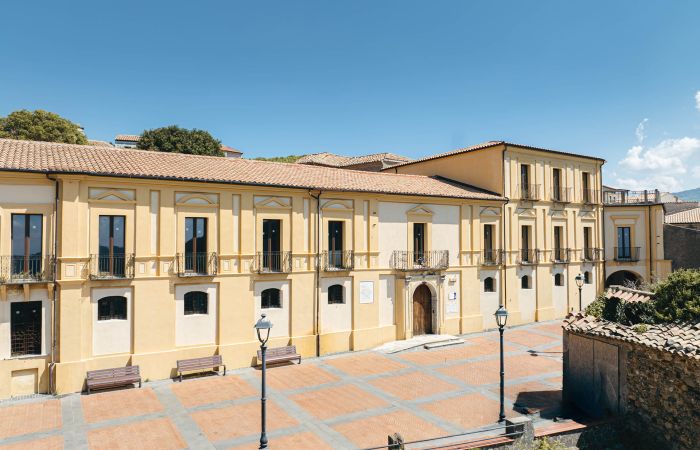


At the highest point of Curinga’s historic center—offering a sweeping view of the plain below—stands the imposing Palazzo Bevilacqua. This sumptuous aristocratic residence tells an extraordinary story because, unlike many noble palaces of the era, this building served as the hub of the local economy and social life. Two large structures dedicated to industrial and agricultural activities were subsequently annexed to the original residential core, which had been built in the second half of the 18th century. The palace thus transformed into a truly cutting-edge production center, featuring a silk mill, an olive oil press, and a grain bank (*monte frumentario*). The Church of San Giuseppe stands near the palace, surrounded by the homes of silk workers and farmers, as well as stables. The architecture itself reflects this dual nature. The central section features a rigorous Neoclassical façade and a portal embellished with late 18th-century decorations. On the ground floor—behind tall windows protected by antique iron grilles that once guarded the storerooms—lies a spacious atrium. Here, one can still see three deep grain pits carved directly into the rock, utilizing a preservation technique inherited from the ancient Romans. From here, a barrel-vaulted staircase branches off, leading to the *piano nobile* (main floor)—a space of pure beauty. The spacious reception halls feature ceilings entirely covered in painted canvases, created in the late 19th century by Calabrian artists Carmelo Zimatore and Diego Grillo. They depict allegorical scenes, floral patterns, and classical symbols inspired by the great Italian decorative tradition. Today, the palazzo continues its cultural mission, welcoming visitors as the main venue for the *Museo del Territorio* (Local Heritage Museum).
Best time to visit
Year-round, during opening hours.
Accessibility
The building has been recently renovated, and its three exhibition levels are fully accessible.
Local culture
The palazzo’s halls house the permanent archaeological section of the *Museo del Territorio*.
Recommended itinerary
The palazzo serves as an ideal starting point for the *Museo Diffuso* (Distributed Museum) and for a walk through the historic center’s alleys to visit the town's ancient places of worship. Outside the town, you can reach the Hermitage of Sant’Elia Vecchio and the monumental plane tree; further down toward the plain and the coast, you can visit the Roman Baths and the coastal towers.