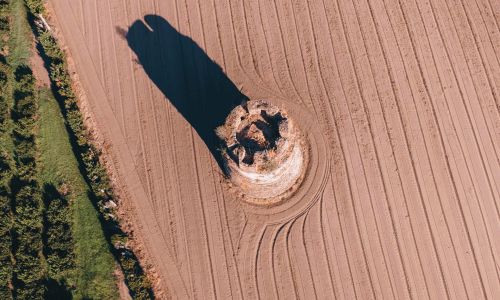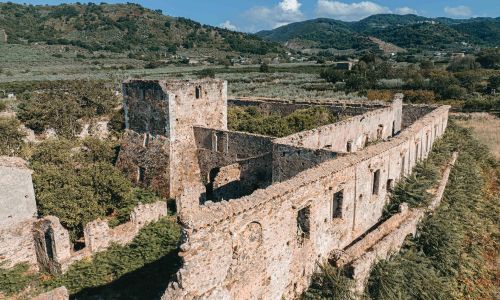
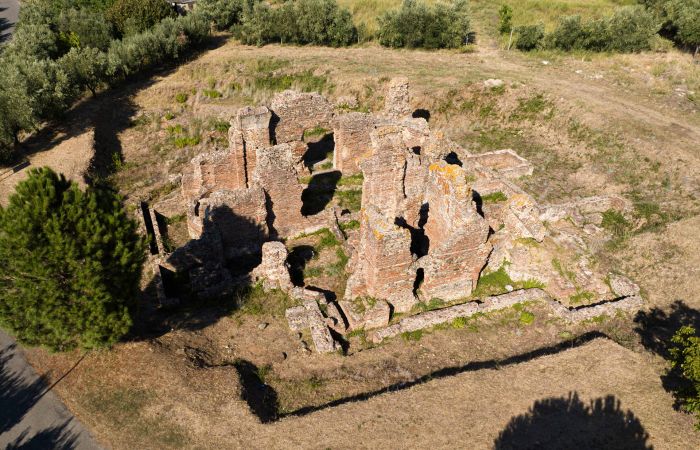


The hamlet of Acconia di Curinga stands upon the remains of the settlement the Greeks called Laconia, which the Romans transformed into a key junction on the Via Popilia—the consular road stretching from Capua to Reggio Calabria. The site is home to Roman baths, long known by the evocative, albeit inaccurate, name "Temple of Castor and Pollux." Built between the 1st and 2nd centuries AD using the *opus testaceum* technique—featuring square *bessales* bricks (roughly 20 cm on each side) laid in courses—the walls remain preserved to nearly their original height (reaching up to five meters above ground in places), allowing visitors to step inside actual architectural spaces from two millennia ago. The exceptional state of preservation of the perimeter walls makes this site unique in Italy. The complex centers on the *frigidarium*, a large rectangular hall (80 square meters) featuring two semicircular apses—which housed cold-water pools and statue niches—and a complex vaulted roof. The *calidarium*, oriented southwest in accordance with Vitruvius’s precepts to harness solar heat, consisted of two apsidal chambers, each equipped with a *praefurnium* (furnace). The clear layout of the spaces—including heated rooms, the *tepidarium*, and the *laconicum*—illustrates the complete functional sequence typical of imperial baths. The complex underwent modification at least three times over the centuries, with excavations conducted between 1991 and 2007 documenting six distinct phases. By the mid-4th century, the baths ceased to function and were stripped of all reusable materials for other construction projects. Today, this area of approximately 1,000 square meters continues to tell the story of the Romans' relationship with a peripheral part of the Empire; above all, it stands as a testament to ancient hydraulic engineering and the daily life of the era—a time when there was also room to rejuvenate both body and spirit. Best time to visit Year-round. Accessibility The archaeological site is located in the countryside and is open to the public. The path features uneven terrain and natural obstacles. Local culture The area surrounding the Acconia Plain is renowned for intensive strawberry cultivation—a true symbol of local agricultural excellence. Recommended itinerary The Roman Baths site is one of the stops on the "Curinga Territory Distributed Museum" (*Museo Diffuso del Territorio di Curinga*) circuit. To complete the tour of the area's iconic monuments, you will need a car or bicycle: from here, you can travel about 6 kilometers up to the Historic Center, or continue another 4 kilometers toward the mountain area, where the walking trail to the Sant’Elia Vecchio Monastery and the Vrisi Plane Tree begins.
Best time to visit
All year round.
Accessibility
The archaeological site is located in the countryside, and access is free. The path has an uneven surface and features natural obstacles.
Local culture
The area surrounding the Acconia Plain is renowned for intensive strawberry cultivation—a true symbol of local agricultural excellence.
Recommended itinerary
The Roman Baths site is one of the stops on the “Curinga Area Distributed Museum” (Museo Diffuso del Territorio di Curinga) itinerary. To complete the circuit of landmark monuments, you need to travel by car or bicycle: from here, you can head up about 6 kilometers toward the historic center, or continue for another 4 kilometers toward the mountain area, where the walking trail to the Sant’Elia Vecchio Monastery and the Vrisi Plane Tree begins.