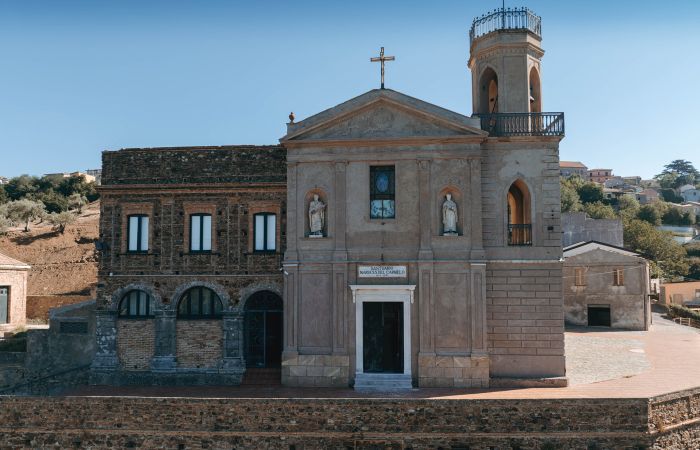


Perched on a rise just above Curinga’s historic center—where the Lamezia Plain opens up to a magnificent view of the Tyrrhenian Sea and the Aeolian Islands—the Sanctuary of Maria Santissima del Carmelo has stood tall with its soaring bell tower for nearly four centuries. Parish records confirm the construction of the small friary as early as 1629, while the church’s foundation stone was laid on October 25, 1652, by Monsignor Giovanni Tommaso Perrone. Carmelite friars moved there around 1662 from the Sant’Elia Vecchio convent; parts of that earlier structure—specifically dressed stone blocks featuring Doric moldings—were repurposed for the Romanesque peristyle (featuring three semicircular arches) attached to the Sanctuary. The earthquake of 1783 left the building largely in ruins, and restoration work dragged on until the early 19th century. It was not until the period between 1865 and 1911 that the church took on its current appearance, thanks to the Guzzi masters from Miglierina, who richly embellished the interior with stucco work, painted decorations, and gold leaf gilding. The sanctuary features a single nave covered by a barrel vault; beyond the triumphal arch, the eye is drawn upward to the circular dome, which rests on an octagonal drum. In the circular apse, the polychrome marble high altar houses a wooden statue of Our Lady of Mount Carmel, while the organ built in 1845 by Giuseppe and Rosario Tamburelli remains in the choir loft. In the early 1900s, Agostino Guzzi completed the tall, simple Neoclassical façade; adorned with pilasters and cornices and crowned by a triangular pediment, it features two symmetrical niches containing statues of the Prophet Elijah and Saint Simon Stock. The bell tower on the right changes shape as it rises: square at the base and octagonal at the top, featuring pointed-arch windows. Beyond the beauty of this sacred site, there is also the story of a miracle that took place here. On February 2, 1909, during the Candlemas Mass, lightning entered the church through the bell tower, traveled the length of the nave, and exited through the wall, leaving only a small hole; the worshippers present were left in disbelief but unharmed. The event is commemorated to this day by a marble tile at the exit point and by a votive painting. In 1981, bronze doors created by sculptor Giuseppe Farina were inaugurated; they depict the history of the Carmelites in Curinga, Saracen raids, and episodes from the life of the Prophet Elijah, culminating in the image of Christ Crucified. Beneath the church lie three circular, vaulted chambers carved into the sandstone: this is the ancient convent burial ground used by the Carmelite friars. Deceased friars were laid in a seated position on rock-hewn benches, and each chamber still retains a drainage channel and a collection pit in the center of the floor. 20. Best time to visit
Best time to visit
Year-round, during opening hours.
Accessibility
There are architectural barriers at the church entrance, which is preceded by three stone steps at the main portal and lacks fixed ramps; the underground burial chamber, accessible only via narrow, steep stairs, is closed to visitors for safety and preservation reasons.
Local culture
July 16th is the day dedicated to the major celebrations for the Feast of Our Lady of Mount Carmel, drawing the faithful from the surrounding area.
Recommended itinerary
The sanctuary is located just outside the town. From here, you can drive a short distance up to the historic center to visit Palazzo Bevilacqua and the Mother Church, or head towards the Hermitage of Sant’Elia Vecchio and the ancient plane tree.