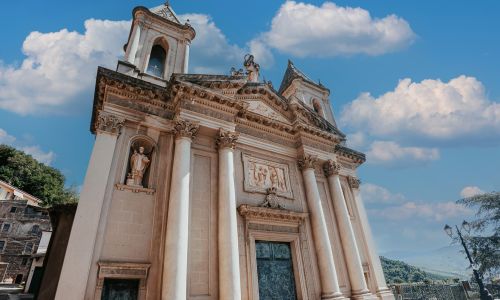
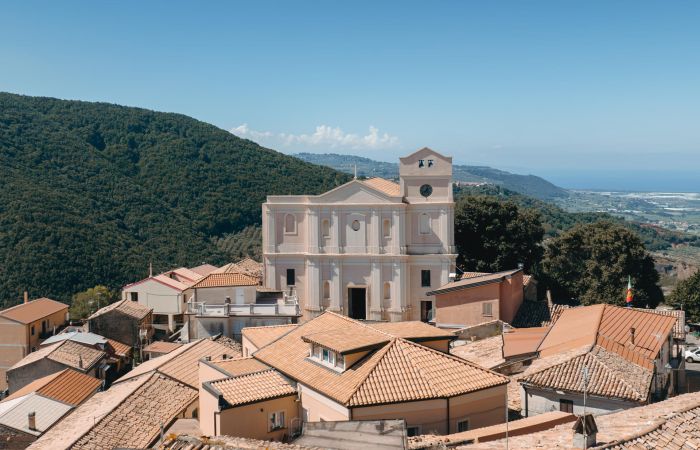


At the point where the old village seems to break off, overlooking the open void, stands Curinga’s main church, dedicated to Saint Andrew the Apostle. Perched on the very edge of the hill—its massive walls acting almost like a buttress—it appears to guard the houses clinging to the steep slope that descends toward the gorge of the Turrina stream. The earliest confirmed records date back to a document from 1595, which identifies it as the sole religious focal point for the entire settlement of Curinga, then under the jurisdiction of Maida. The church was almost entirely rebuilt following the earthquakes of 1638 and 1783, which devastated much of Calabria. Its current profile features a main façade divided into two levels topped by a triangular pediment, with wall niches originally intended to house sculptures that were never installed. To the right rises a square bell tower; its internal ramp reveals sophisticated engineering, featuring sedimentary rock blocks shaped to interlock perfectly. The interior is organized into three naves terminating in a semicircular apse; the two side naves each end in a rectangular chapel. The spacious central nave—eight meters wide—is flanked by two side naves, each four meters wide, defined by square pillars featuring pilasters and composite capitals decorated with vegetal motifs. The Mother Church also serves as a veritable gallery of sacred art, housing altarpieces and wooden statues dating from the 17th and 18th centuries, alongside various 18th-century silver liturgical objects. However, its most prized feature is the marblework, which bears a distinctly Neoclassical stamp, evident in the clean, geometric lines of the elevated pulpit, the baptismal font, and the holy water stoup. Equally extraordinary is the village’s historical memory preserved in the Parish Archive: an intact collection of documents dating back to 1650 that chronicles three centuries of human history.
Best time to visit
Year-round, during opening hours.
Accessibility
There are no architectural barriers.
Local culture
The historical archive housed within the parish is a treasure trove of memory for the community; it contains the old registers in which priests recorded harvests, births, and the fears experienced during great calamities.
Recommended itinerary
A short walk through the narrow streets leads to Palazzo Bevilacqua, while outside the village one can visit the Hermitage of Sant’Elia Vecchio and the monumental plane tree; heading down to the plain and towards the coast, one can visit the Roman Baths and the coastal towers.