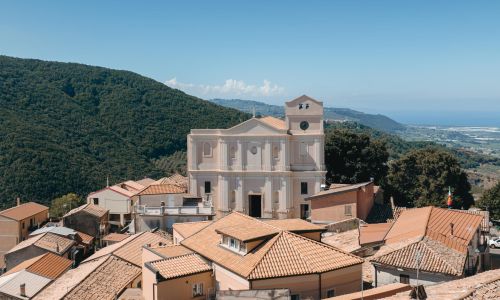
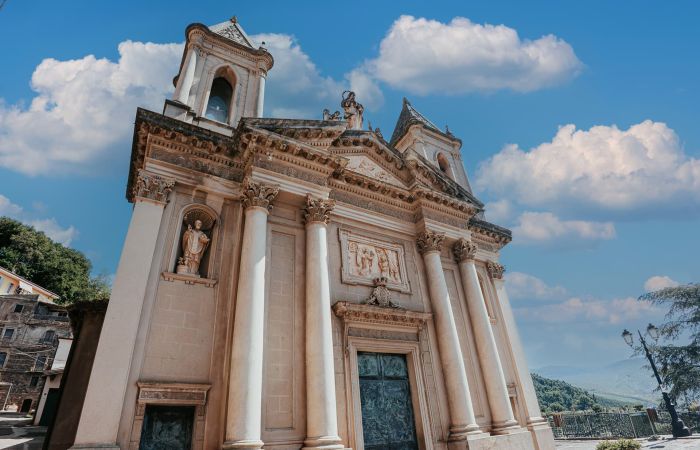


Like other places of worship, the Church of the Immaculate Conception (*Chiesa dell’Immacolata*) integrates harmoniously into Curinga’s historic urban fabric. Its forecourt opens onto the square of the same name, popularly known as "*u passu*" (the passage). This name stems from the church’s unique location; originally separated from the rest of the town by a canal, it was often isolated, and access was possible only via a narrow passageway—a feature that now gives the entire area its name. The building, which certainly existed prior to 1640, was originally dedicated to Saint Nicholas; it retained this dedication until 1733, when the Confraternity of the Immaculate Conception relocated there, bringing its own altar with it. Damaged in the 1783 earthquake, the church underwent various renovations and restorations, eventually acquiring its current Latin-cross layout with three naves and a crypt (which is, unfortunately, inaccessible). A substantial thirteen-meter transept intersects the nave beneath a tall, spacious *tiburio* (a lantern-like structure enclosing the dome). The semicircular apse is capped by a semi-dome (*catino*) richly decorated with phytomorphic stucco motifs. Inside, the walls are entirely white—lending a sense of lightness to the space—while the stucco details are highlighted with gold accents. The high altar features a 16th-century wooden statue of the Madonna by an unknown artist. In 2022, while the Confraternity’s archives were being reorganized, a relic of Saint Francis of Assisi was rediscovered; donated to the church in 1893 and forgotten for nearly 130 years, it is now once again on display for the veneration of the faithful. The exterior façade presents a compact design, flanked by two bell towers positioned in a staggered arrangement relative to the columns. Rising from square bases, these elements support an entablature decorated with elegant plant-like reliefs. Above the entrance, a high-relief of the Annunciation is visible, while the expulsion of Adam and Eve from Eden can be seen in the tympanum. The pediment is crowned by a large statue of the Immaculate Conception, flanked by two adoring angels. Three bronze portals, cast using the lost-wax technique, open onto the lower register. In the central portal—dedicated to the Immaculate Conception—a main relief depicts the silhouette of Curinga against the backdrop of the sacred scene, featuring two projecting *putti* holding the text of the Gospel of Luke. Four smaller panels illustrate episodes from Genesis, the Visitation, the Motherhood of Mary, and the proclamation of the Dogma, while the side portals pay homage to Saint Francis of Assisi and Saint Nicholas of Bari.
Best time to visit
Year-round, during opening hours.
Accessibility
There are no architectural barriers; the inner crypt is closed to the public.
Local culture
The Confraternity of the Immaculate Conception is a touchstone for the town’s identity: it preserves works of sacred art and passes down the solemn rites associated with the village’s festivities.
Recommended itinerary
A short walk through the narrow streets leads to Palazzo Bevilacqua, while outside the village one can visit the Hermitage of Sant’Elia Vecchio and the monumental plane tree; heading down to the plain and towards the coast, one can visit the Roman Baths and the coastal towers.