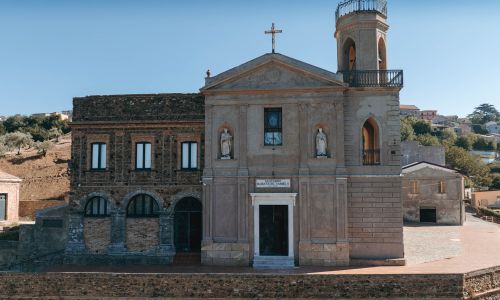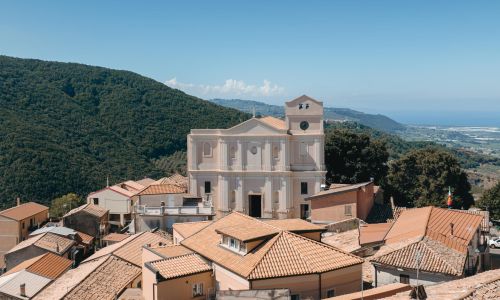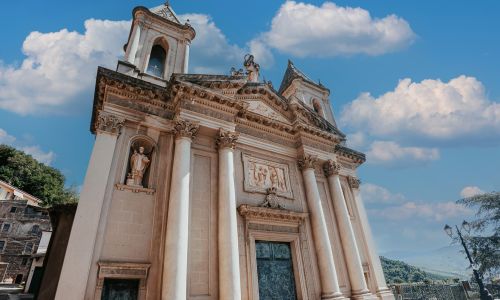
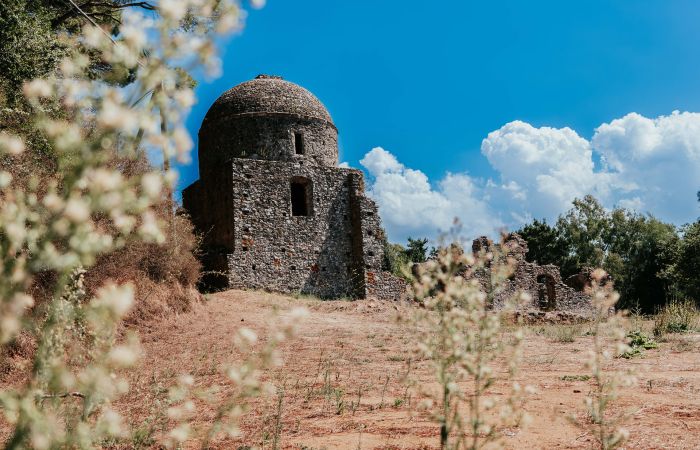


The monastery of Sant’Elia Vecchio in Curinga stands at an altitude of 530 meters—similar to that of Mount Carmel in the Holy Land. While this might seem like a coincidence, it is a spiritual connection that links the site to the Carmelite tradition. Local legend holds that the monastery was founded by Basilian monks who arrived from the East in ancient times, fleeing Saracen raids and taking refuge in the area now known as Corda. However, excavations led by archaeologist Francesco Antonio Cuteri in 1991 reveal a different story. The first confirmed record of the monastery dates to 1493, in a papal bull issued by Pope Alexander VI (Borgia) granting the building *in commendam* to a boy of just thirteen, Lodovico Serra. The dome of the *Sancta Sanctorum*—long thought to be of Byzantine origin—is also a later creation; its interior braided decoration dates to the 17th century, the work of stonemasons from Rogliano, and reflects the patronage of the Loffredo and Caracciolo families—lords of Maida—whose coat of arms is still visible on the exterior. In 1632, the building passed to the Carmelite Reform of Monte Santo; the monks abandoned it in 1662 following damage from the 1659 earthquake, and by 1726, a visiting bishop found it already in ruins. The 1991 excavations unearthed the entire floor plan, comprising thirteen rooms divided into three sections: the church with its unfinished *Sancta Sanctorum*; the Chapel of Sant’Elia—the oldest part, dating to the late 14th or 15th century; and, further uphill, the monastic quarters proper, including the kitchen, refectory, pantry, and the cell that housed the prior. Inside the chapel, a small well and a narrow channel directed water—fed by an ancient terracotta aqueduct—down the entrance steps; this served as a rich symbolic reference to the Spring of Elijah at the original oratory on Mount Carmel and to the vision of the prophet Ezekiel, in which life-giving water flows from the threshold of the Temple. A walk to this spot offers a connection to the history of the nearby Sanctuary of Carmel—founded in the village by the same monks before they left this hermitage—and to the majestic Vrisi Plane Tree, located just a short distance away.
Best time to visit
All year round.
Accessibility
Admission to the area is free. The resting area is close to the paved road, but the space within the ruins features changes in level and stone thresholds.
Local culture
For the community of Curinga, Saint Elijah is historically the protector to be invoked during periods of severe drought to ask for the gift of rain.
Recommended itinerary
The site is part of the "Museo Diffuso" (Distributed Museum) project. Just outside the ruins, simply cross the small road to take the footpath that descends through the woods and leads directly to the Vrisi Plane Tree.